
The South Transdanubian Regional Innovation Agency (STRIA) organized the online stakeholder meeting of the RESONANCE and SMARTAUTO Interreg Europe projects on April 29, 2026. While the former project supports the development of environmentally friendly and energy-efficient communities, the latter supports the increased spread of autonomous vehicles in European regions.
RESONANCE – Local Stakeholder Group meeting
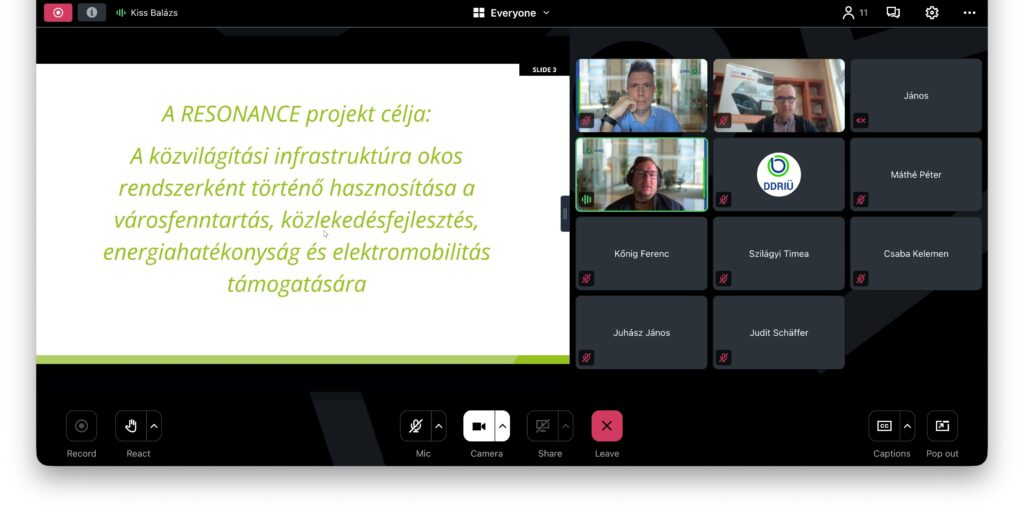
The meeting, attended by 12 people, following the kick-off presentation of the RESONANCE project (smaRt polEs aS driver Of greeN And eNergy effiCient communitiEs) continued with the presentation of the Good Practice of the city of Coimbra (Portugal). Two-thirds of the municipality’s energy consumption is provided by public lighting. The reduction in consumption was based on preliminary research, luminous flux testing and other tests, and the selected technical solution was concluded with the company that submitted the most favorable offer under the so-called Energy Performance Contract (EPC), which is practically ESCO financing.
STRIA, as the Hungarian partner of the RESONANCE project, also presented the Danube Indeet project of the City of Paks, co-financed by the Danube Region Programme, as another Good Practice. This project aims to bring renewable energy production into line with the electromobility and green hydrogen sectors. In the Danube Indeet project, the model based on the optimization algorithms called Danube Indeet Model developed by the University of Zagreb aims to design and schedule green infrastructure. This model was validated by Paksi Közlekedési Kft. based on its own data and then applied to the Kiskunvíz wastewater treatment plants in Kiskunmajsa and Kiskunhalas, where it modeled energy efficiency investments with a solar system and energy storage. According to the calculations, the investment costs of 186,300 and 370,400 euros, respectively, will be repaid in approximately 4.5 years in both cases.
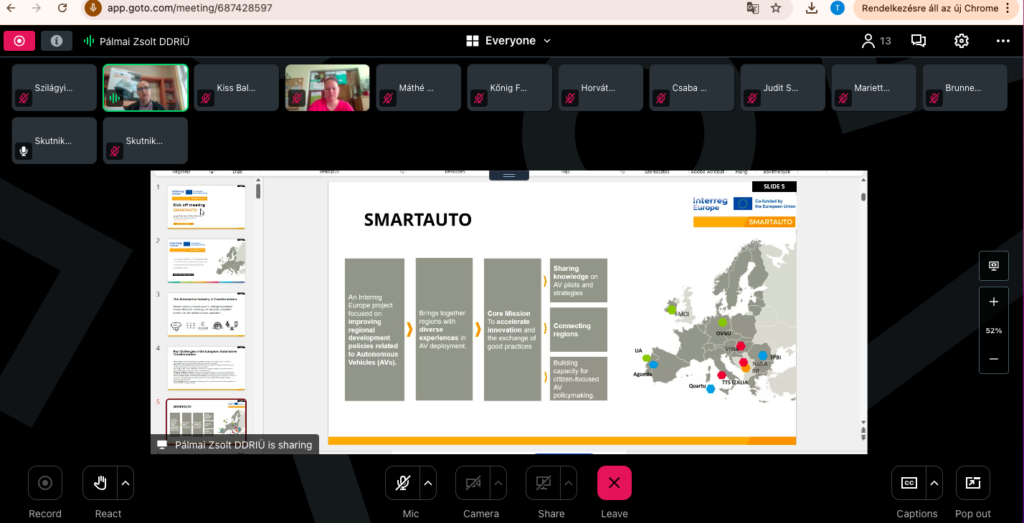
SMARTAUTO – Regional Stakeholder Meeting
In the second half of the online event, after presenting the main elements of the SMARTAUTO project (Smart Policy Innovation for Enhanced Automation in European Transport), we presented two Good Practices.
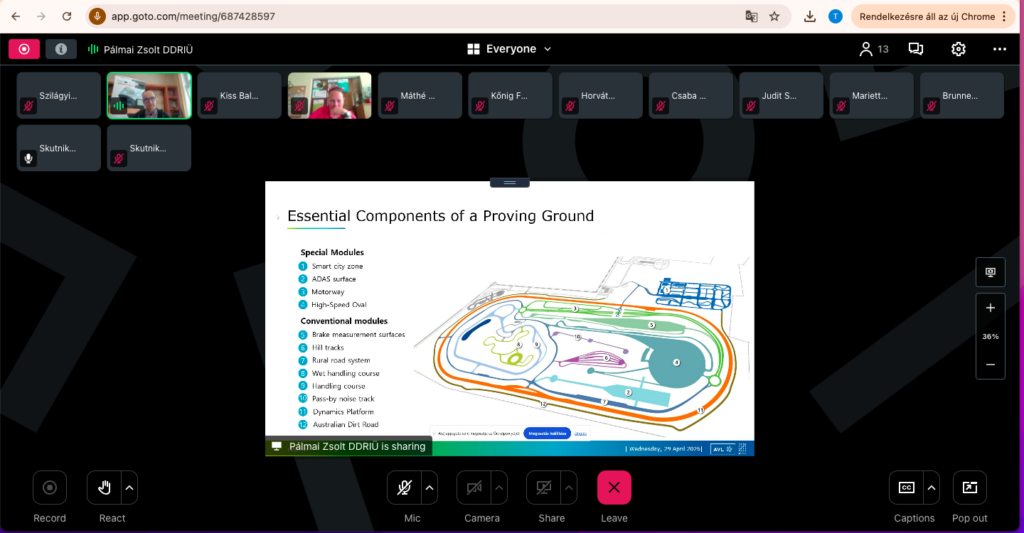
The ZalaZONE proving ground in Zalaegerszeg has European relevance beyond the automotive industry investments in Hungary. Although it was not created directly for the testing and homologation of automated vehicles, by using AI it is suitable, among other things, for determining the driver’s state of consciousness with the help of a driver monitoring system, performing accident avoidance and emergency braking tests, and examining cooperation with pedestrians and other road users. It also provided the opportunity to test road situations that arise in roundabouts and intersections for automated vehicles. The world-class facility, built on 250 hectares with a domestic central budget sources of approximately 150 million euros was completed in 2022, and is the third largest and most modern proving ground in Europe, after Papenburg (Germany) and Barcelona (Spain).
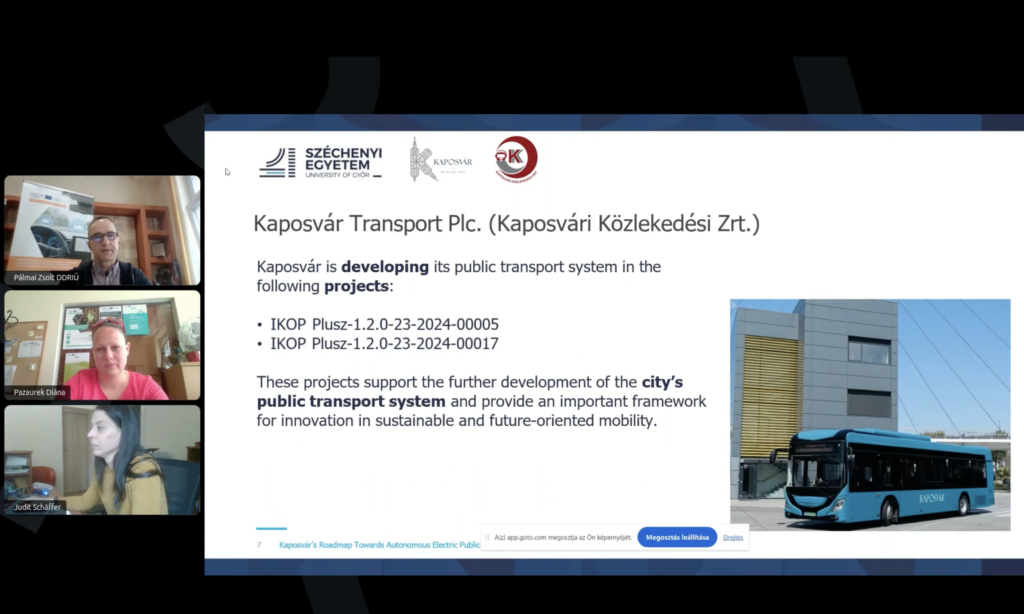
The other domestic Good Practice is related to Kaposvár (located in the South Transdanubian region) and is being implemented with the support of the Integrated Transport Development Operational Programme Plus (ITDOP Plus), within the framework of the IKOP Plusz-1.2.0-23-2024 call for proposals (strengthening clean urban suburban transport). The Kaposvár autonomous electric bus service will establish a new public transport access option within the city on a 4.7-kilometer line, using two automated buses currently under procurement, that will provide service on a two lane route. The maximum speed of the vehicles is 50 kilometers per hour, which is maximized at 30-40 kilometers per hour on certain sections (roundabouts, intersections, significant pedestrian traffic). According to the plans, the capacity of the buses will allow the transport of 40-50 passengers. Additional cameras connected to the closed-circuit system of the city will be installed on the line, as well as eight pairs of bus stops, one terminal, and two bus turns will be designated / established. The domestic legal regulation will need to be changed in order for this automated mobility bus service, which will initially operate as a test operation. On longer run, hopefully, it will also function as a regular scheduled bus service.
You can find more information about the projects on our website and on the official websites of the two projects (https://www.interregeurope.eu/resonance, https://www.interregeurope.eu/smartauto).
The participation of the South Transdanubian Regional Innovation Agency in the Interreg Europe Programme is co-financed by the European Regional Development Fund and Hungary.